
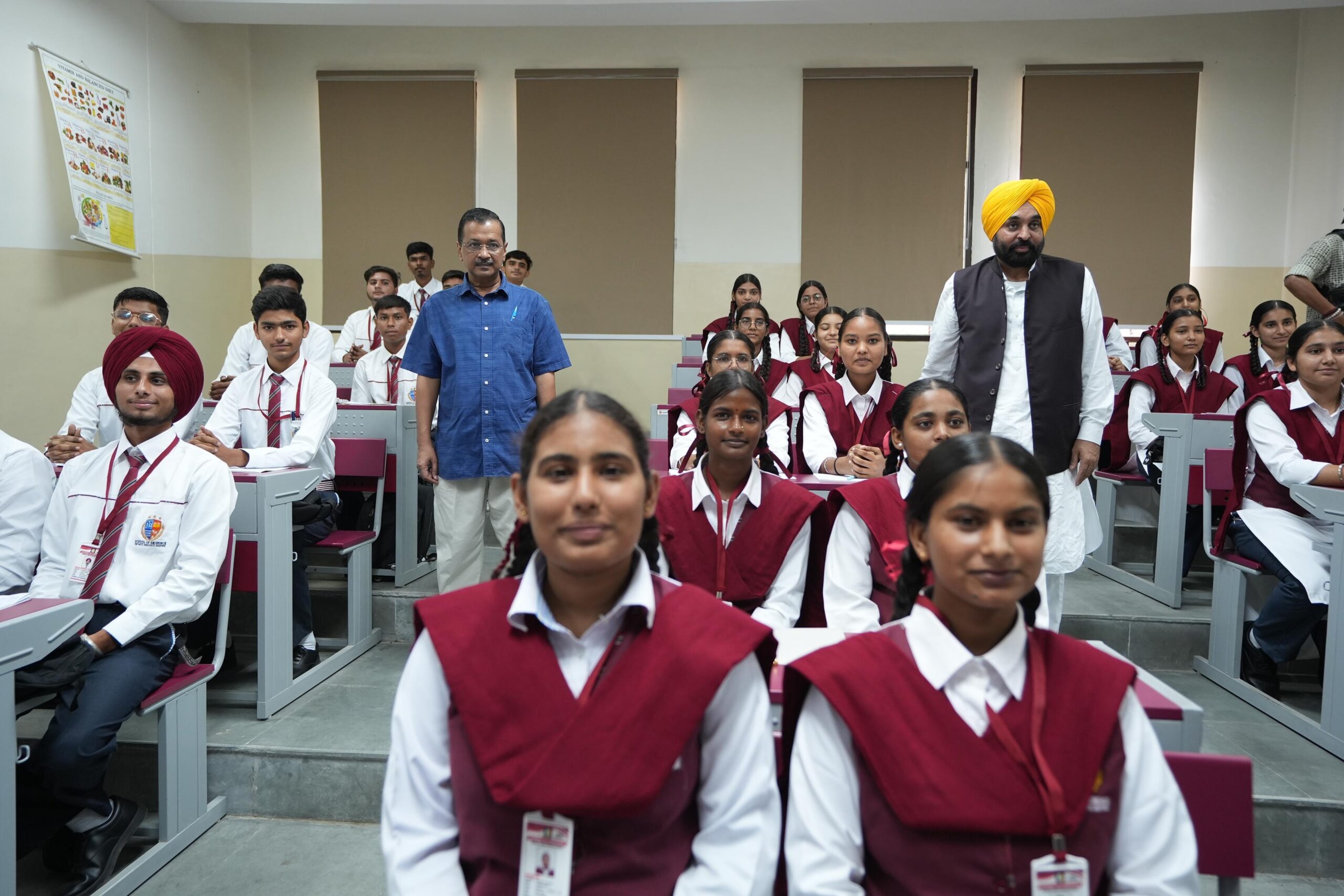
In a major step towards making Punjab drug-free, the Aam Aadmi Party (AAP) government has launched an anti-drug curriculum in 3,500 government schools to educate children from an early age. On Friday, AAP National Convenor Arvind Kejriwal and Chief Minister Bhagwant Mann formally rolled out the programme at Fazilka’s School of Eminence (SoE), where participants also took a collective pledge against drugs.
The curriculum, now being taught from Classes 9 to 12, aims to prepare students to resist addiction and shape a generation defined by knowledge and resolve, not substance abuse. Party leaders including Punjab Prabhari Manish Sisodia and Education Minister Harjot Singh Bains were also present at the event.
On this occasion, AAP National Convenor Arvind Kejriwal stated, “Today marks a truly historic moment — when children will begin receiving anti-drug education from an early age as part of their school curriculum. The drug menace in Punjab is not something that developed overnight. For many years, Punjab has been grappling with the crisis of drugs.”
Referring to the onset and political patronage of drugs, Arvind Kejriwal said, “Drugs began infiltrating Punjab around 2007-08. Since then, governments have come and gone — some with ministers who openly sold drugs. There were ministers who supplied drugs using their official vehicles. International drug smugglers began arriving from abroad, and they were hosted inside the homes and mansions of these ministers. Successive governments took no action against this epidemic.”
Recalling the people’s mandate in 2022, he said, “Frustrated and helpless, the people gave a new party — Aam Aadmi Party — a chance in 2022. They had lost all hope in the Congress, BJP, and Akali Dal. They paved the way for us to do something, to bring change.”
Highlighting the recent crackdown, the AAP Supremo added, “In the last few months, ‘Yudh Nashe ke Virudh’ (war against drugs) has begun — nothing like it has been seen across the country. Drug dealers are being relentlessly arrested and sent to jail. In just five months, over 23,000 FIRs have been registered, and more than 15,000 people have been arrested and jailed. These drug peddlers had built massive mansions with their dirty money — large estates and buildings — and bulldozers are now razing them to the ground. No government before us had the courage to act against drug dealers. Everyone was afraid of them.”
Asserting his party’s resolve, the AAP National Convenor stated, “But the Aam Aadmi Party government is honest, brave, and fearless. We are not afraid of anyone. Even the biggest drug lords are being thrown in jail. Just recently, a very prominent leader — known to everyone — was arrested for his role in the drug racket.”
Referring to public reaction, Arvind Kejriwal said, “We received countless phone calls. Mothers and sisters who had lost husbands or children to drugs said, through tears, that their souls finally feel at peace. But when we put him in jail, the Congress, BJP, and Akali Dal all came out in his support, crying foul — claiming injustice was done to him. But where were their tears for the children and families destroyed by drugs? Why did they not cry then?”
Pointing to political hypocrisy, he said, “We jailed one of the biggest drug traffickers, and now the Congress sheds tears, the BJP weeps, and the Akali Dal hurls abuses at us. But when Punjab was being looted, when its youth were being destroyed, these parties were silent. Today, their assets are being seized — their bank accounts frozen, their land and properties confiscated. And with that recovered money, we are building new schools and hospitals for you.”
Stressing on public participation, Arvind Kejriwal said, “This war against drugs cannot succeed unless every single person and every child in Punjab becomes a part of it. We recently launched an anti-drug awareness yatra that has already reached about 10,000 villages and wards. Whole villages are gathering and taking collective oaths that they will not allow drugs to be sold in their areas.”
On strengthening infrastructure, he said, “All existing de-addiction centers have been upgraded and improved. Earlier, no one wanted to go to those centers due to their poor condition. Now, we’ve assigned duties at the village level — youth volunteers are being tasked with identifying drug users in their localities and taking them to the nearest de-addiction center to save their lives.”
Announcing the launch of a new curriculum, Arvind Kejriwal said, “Starting today, this anti-drug curriculum is being introduced in 3,500 government schools across Punjab. Children will now be educated from a young age. This is the age when they are most vulnerable, when peer pressure is highest. A friend might say, ‘Try it once, nothing will happen.’ The child thinks the same — ‘Just one time, I won’t do it again.’ That very thought — ‘Let me try it once’ — becomes the worst day of their life. It never stops at once. It becomes twice, thrice, and eventually destroys lives.”
Arvind Kejriwal said, “Manish Sisodia, Bhagwant Mann, and I have spoken to several children at de-addiction centers. We asked how much money is needed daily for drugs. They said ₹4,000 a day. How will a child from a poor family afford ₹4,000? Then he picks pockets, steals from home, commits crimes, uses knives — and from there, life begins to fall apart.”
The AAP Chief continued, “That’s why we’ve built such excellent schools for you. Just today we visited one school — and there are many more like it across Punjab. All schools have been improved. We spoke to several students today. Every child has a dream — someone wants to be an IAS officer, someone a doctor, engineer, lawyer, singer, or artist. These dreams are beautiful. Dream big — you are the ones who will take Punjab forward. Tomorrow, one of the children sitting in front of me will be the Chief Minister. Tomorrow, one of these children will become Punjab’s Education Minister— but only if you stay away from drugs.”
Recalling the failures of past governments, Arvind Kejriwal said, “This government is making such extensive arrangements for quality education for you. The previous governments had completely ruined public schools. But our ministers, MLAs, officers — everyone is working day and night to improve education. When children receive quality education, they progress. Your parents also have big dreams for you. But the day you fall into drugs, your parents break, your society breaks.”
He added, “I believe the syllabus being introduced today will set an example not just for Punjab but for the whole nation. It will show the country how to prepare children to resist drugs. Today it is starting in 3,500 government schools, and soon it will expand to all government schools, private schools, and colleges as well. We want every child to grow up strong enough to never fall into addiction.”
Calling this mission a moral duty, Arvind Kejriwal said, “This war against drugs is not just a government initiative. It is not a political agenda. It is a sacred mission. When we visit villages and hear people’s stories, our hearts break. Bhagwant Mann and I were sitting on stage earlier when he shared a story — a boy said that when his father died, he was so addicted that he pulled money from his father’s dead body’s pocket. The boy said, ‘I used to own land. Today I work as a laborer on the same land because drugs took everything from me.’”
Issuing a final appeal, Arvind Kejriwal said, “You don’t want to lose everything, right? We all want our families and Punjab to progress. So let’s all take a pledge today — that we will never touch drugs. Don’t even fall for that first taste. Never try it even once. It’s poison. It will consume you — and your family.”
Previous governments stained Punjab with the blot of drugs for their own selfish interests; We are working to erase that stain: Bhagwant Mann
Meanwhile, Punjab CM Bhagwant Mann said, “Due to the unprecedented efforts of the state government, government schools have been transformed. Now, students are leaving private schools to enroll in government schools — a clear reflection of restored public confidence.”
On the grim necessity of drug awareness programmes, he said, “Ideally, there should never have been a need for such programmes against drugs. But unfortunately, Punjab has been trapped in such conditions that these initiatives have become necessary.”
Lashing out at past regimes, Bhagwant Mann stated, “Former governments planted the stigma of drugs on Punjab’s forehead. After we assumed office, it took us time to devise a strategy. Now, the state government has launched de-addiction centres for treatment and is also working to skill these youth, so they can live with dignity and self-respect.”
Giving an update on the crackdown, Bhagwant Mann said, “This war against drugs has been ongoing for the past 150 days. Hundreds of panchayats have passed resolutions pledging never to support drug peddlers. This battle has now become a public movement.”
Explaining steps taken in schools, he added, “As part of this movement, anti-drug education has been included in the school curriculum. Students will be made aware of the symptoms and dangers of drug use, because that very first use marks the beginning of a ruined life.”
Rejecting electoral motives, Bhagwant Mann said, “We do not indulge in vote-bank politics. Schoolchildren don’t even have votes, yet we are determined to educate them against this curse. The earlier governments protected the drug trade and destroyed our youth.”
Exposing the elite-political nexus, he said, “These leaders and their parties ran businesses in the hills, bought land there. Their children went to school under the protection of armed guards. The state government has taken decisive action against such leaders.”
On the political backlash during enforcement, Bhagwant Mann remarked, “When Bikram Majithia was arrested, Congress, Akali Dal, and BJP all rushed to defend him. Some leaders had once claimed they would drag Majithia by his collar — but now they stand in his support.”
On the political-business interests fueling drug trade, he said, “In their greed for illegal money, these leaders looted and destroyed Punjab. Ministers’ official vehicles were used to supply packets of drugs. Drug traffickers were considered close friends of those in power, which is how drugs spread across the state.”
Bhagwant Mann declared, “The government will continue its legal battle against Majithia until he is punished severely for his crimes. Sukhbir Badal only knows his relatives’ names — he is unaware even of Punjab’s basic geography. People elected the Badals repeatedly, but they never cared for the state or its people.”
On constructive youth engagement, the Chief Minister said, “To keep the youth away from the menace of drugs, the Punjab government is constructing sports grounds and gyms in every village.”
Urging public cooperation, he added, “A dedicated WhatsApp number, 97791-00200, has been launched for people to report drug trafficking. The identity of informants will be kept completely confidential.”
On rehabilitation efforts, Bhagwant Mann concluded, “We are also working to rehabilitate those coming out of addiction, so they can once again stand on their feet and live with respect and dignity.”