
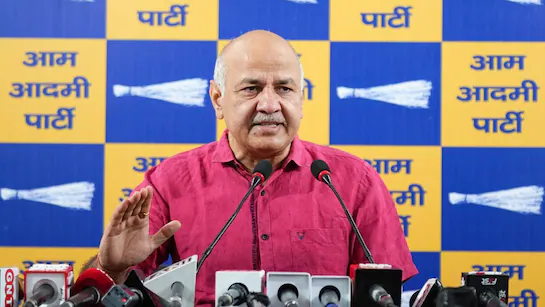
In a bold move aimed at shaking the foundations of India’s outdated education system, senior AAP leader and father of Delhi’s education revolution, Manish Sisodia, launched a groundbreaking video series titled “Education Systems of the World and India” on Friday. Positioning education as the engine of national progress, Manish Sisodia called on citizens to become informed and demand the same quality of education for their children as seen in the world’s most developed nations.
Citing the meteoric rise of countries like Japan, Singapore, China, Canada, and Finland—nations that invested heavily in education—Manish Sisodia delivered a blunt message: “India will only change when its education changes, and education will only change when the thinking of our leaders changes. If their thinking doesn’t change—change the leaders.”
In the first episode of this series, senior AAP leader and father of Delhi’s Education Revolution Manish Sisodia shared that this series was born from a recent public conversation he had with Grok AI on education. “Millions of people read our chat, asked questions, and offered suggestions. There was a deep curiosity about how the world educates its children and where India stands in comparison. That interest has motivated me to start this series.”
Japan: Education as National Character Building
Citing the example of Japan, Manish Sisodia noted that the country made education a state responsibility back in 1872—more than a century before India passed its Right to Education Act in 2011. “Japan’s education empowered every citizen so strongly that even after being devastated by nuclear attacks, they stood up again with renewed strength,” he said. Japan’s revival in technology, research, and industry, he argued, was powered by its education system. “In Japanese schools, children don’t learn ‘I’, they learn ‘we’. Education begins with teamwork. Patriotism and responsibility aren’t textbook chapters—they’re daily habits. There are no janitors; children clean their own classrooms, toilets, corridors. Japan built national character through education.”
Singapore: From Zero Resources to Global Riches Through Education
Manish Sisodia recalled how Singapore, which gained independence 18 years after India in 1965, began its journey with no land, water, minerals, or money—conditions not unlike the jhuggis of Delhi and Mumbai. “Their first Prime Minister Lee Kuan Yew wept when Singapore became independent, but he believed in one thing: our children. He said, we’ll give them the best education—and on their strength, we’ll build a new Singapore. That’s exactly what happened,” said Sisodia. In Singapore, even sanitation workers are trained with the same quality and rigor as engineers. “With zero resources, Singapore is today among the richest countries in the world—because they put every child at the center of their education model.”
China: Education as a Culture of Hard Work
Manish Sisodia pointed out that China’s booming economy and global business dominance stem from an education system that prizes hard work over raw talent. “In China, report cards not only reflect marks but also document effort. While in India we ask, ‘How many marks did you get?’—China asks, ‘How hard did you work?’” He added that China’s education system sends ten messages daily to parents about their child’s effort, conduct, and performance. “Their core message to every child is—hard work is a lifestyle. Chinese students don’t queue up for government jobs; they conquer global markets.”
Canada: Diversity as an Educational Strength
Manish Sisodia highlighted how Canada embraces its multicultural society as a strength in its education system. “More than 100 languages are spoken in Canadian schools. Children come from every country, race, culture, and religion—but Canada sees this as an opportunity, not a threat.” He explained that the Canadian Parliament sets learning goals for children by age, and curricula focus not just on academic knowledge but also leadership, communication, vision-building, and community development. “In India, these are considered extracurricular. In Canada, they are core curriculum. That’s why Canada is a global leader in education.”
Finland: Decades of Global Leadership in Education
Finland, Manish Sisodia said, has remained the global No. 1 in education for decades—not by chance but by deep, structural choices. “The question is not why Finland is No. 1, but how it has stayed No. 1 for so long.” In the 16th century, Finnish society considered a person ready for marriage only if they could read religious texts. Education was not about jobs or degrees but a prerequisite for social life. Post-1947, all political parties came together to overhaul the system. Over 200 meetings were held, and all private schools were nationalized. A new rule was introduced: real learning would begin at age seven. “Before that, children play, jump, explore—they don’t learn ABCs or numbers. They’re taught how to think, understand, and express,” said Manish Sisodia.
He emphasized that Finland doesn’t have school inspectors; it invests in teacher training. Becoming a teacher in Finland is tougher than getting into IIT or IIM. Teacher education spans five rigorous years. “This trust in teachers is what has propelled Finland, Singapore, Canada, and China ahead in education.”
India Must Choose Its Own Path—Rooted in Its Realities
Raising important questions for India’s policymakers, Manish Sisodia concluded: “What model will India follow? Can we trust our teachers? Can we spend on education? Can we end the inequality of private schools?” He cautioned against blindly copying Japan or Singapore. “We are India. Our needs and ground realities are different. The country will change only when education changes. And education will only change when our leaders change their thinking. If the leaders won’t change their thinking—change the leaders.”
He ended with a call to action: “This is our duty as Indians. Choose the kind of leaders who will give our children the kind of education we want.”